Evolúcia vesmíru - kauzalita
Evolution of the Universe - Causality
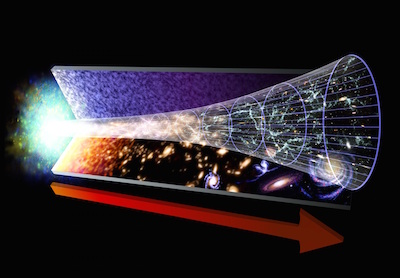
Evolúcia vesmíru
Podľa súčasnej kozmologickej teórie, vesmír vznikol približne pred 13,8 miliardami rokov v události známej ako Veľký tresk (Big Bang). Tento moment označuje začiatok nie len priestoru, ale aj času samotného. Od tohto okamihu vesmír neustále expanduje a chladne, čo formuje štruktúry, ktoré dnes pozorujeme.
Fázy vývoja vesmíru
- Planckova epocha (0 až 10-43 sekundy): Obdobie, kedy kvantové efekty gravitácie boli dominantné. Naše súčasné fyzikálne teórie nie sú schopné popísať toto obdobie.
- Veľké zjednotenie (10-43 až 10-36 sekundy): V tejto fáze sa oddelila gravitačná sila od ostatných síl.
- Inflačná epocha (10-36 až 10-32 sekundy): Vesmír prešiel exponenciálnou expanziou, čo vyriešilo niektoré problémy klasického modelu Big Bangu.
- Elektroslabé narušenie (10-12 sekundy): Elektromagnetická a slabá interakcia sa oddelili.
- Kvark-gluónová plazma (10-12 až 10-6 sekundy): Vesmír bol naplnený hustou, horúcou polievkou kvarkov a gluónov.
- Hadronizácia (10-6 sekundy): Kvarky sa spojili a vytvorili protóny a neutróny.
- Nukleosyntéza (3 minúty): Protóny a neutróny sa spojili a vytvorili jednoduché jadrá prvkov, najmä hélia a malého množstva lítia.
- Rekombinácia (380 000 rokov): Elektróny sa spojili s jadrami a vytvorili neutrálne atómy. Vesmír sa stal priehľadným pre fotóny, čo umožnilo uvoľnenie kozmického mikrovinného žiarenia pozadia (CMB).
- Temné veky (380 000 až 150 miliónov rokov): Pred vznikom prvých hviezd vesmír obsahoval predovšetkým neutrálny vodík.
- Reionizácia (150 miliónov až 1 miliarda rokov): Prvé hviezdy a galaxie začali ionizovať neutrálny vodík.
- Formovanie galaktických štruktúr (1 miliarda rokov až súčasnosť): Formovanie galaktických kôp a super-kôp, ktoré predstavujú najväčšie štruktúry vo vesmíre.
Temná energia a zrýchlená expanzia
V roku 1998 astronómovia zistili, že expanzia vesmíru sa zrýchľuje. Tento objav bol v rozpore s predchádzajúcimi očakávaniami, že gravitačná príťažlivosť hmoty vo vesmíre by mala expanziu spomaľovať. Na vysvetlenie tohto fenoménu bola postulovaná existencia temnej energie.
Temná energia je hypotetická forma energie, ktorá prostupuje celým vesmírom a pôsobí ako antigravitačná sila. Podľa súčasných meraní temná energia tvorí približne 68% energetického obsahu vesmíru. Presná povaha temnej energie zostáva jednou z najväčších záhad modernej fyziky.
Možné vysvetlenie temnej energie
- Kozmologická konštanta: Einstein pôvodne zahrnul tento termín do svojich rovníc poľa ako spôsob udržania statického vesmíru. Neskôr ho označil za svoj "najväčší omyl". Ironicky, teraz sa zdá, že niečo podobné kozmologickej konštante by mohlo vysvetliť zrýchlenú expanziu.
- Kvintesencia: Dynamické pole, ktorého hustota energie sa môže meniť v priestore a čase.
- Modifikovaná gravitácia: Niektorí vedci navrhujú, že namiesto vytvárania nových foriem energie by sa mali modifikovať zákony gravitácie na veľkých škálach.
Kauzalita a šípka času
Kauzalita je princíp, že každá udalosť má svoju príčinu, a táto príčina predchádza následku. Je to základný kameň nášho chápania vesmíru a je úzko spojená s konceptom "šípky času".
Šípka času
Fyzik Arthur Eddington zaviedol koncept "šípky času" na opísanie jednosmerného toku času od minulosti do budúcnosti. Môžeme rozlíšiť niekoľko typov šípok času:
- Termodynamická šípka: Založená na druhom zákone termodynamiky, ktorý uvádza, že entropia izolovaného systému buď zostáva konštantná, alebo sa zvyšuje. Táto šípka určuje smer, v ktorom sa prirodzené procesy odohrávajú.
- Kozmologická šípka: Vyplýva z expanzie vesmíru. Vesmír sa rozširuje smerom k budúcnosti, nie do minulosti.
- Psychologická šípka: Naše vnímanie času, ktoré nám umožňuje pamätať si minulosť, ale nie budúcnosť.
- Kauzálna šípka: Príčina predchádza následku, nie naopak.
Zároveň je dôležité poznamenať, že zákony fyziky na mikroskopickej úrovni sú väčšinou časovo symetrické. Rovnice, ktoré riadia správanie častíc, fungujú rovnako dobre vpred i vzad v čase. Táto asymetria medzi makroskopickým tokom času a mikroskopickou symetriou zostáva fascinujúcim problémom fyziky.
Konečný osud vesmíru
Budúcnosť vesmíru závisí od jeho geometrie, množstva hmoty a energie, a povahy temnej energie. Existuje niekoľko možných scenárov:
- Veľké ochladenie (Big Freeze): Ak bude expanzia vesmíru pokračovať donekonečna, vesmír sa stane stále chladnejším, až nakoniec vyhasne v stave maximálnej entropie.
- Veľké roztrhnutie (Big Rip): Ak temná energia bude naďalej zrýchľovať expanziu, môže dôjsť k "roztrhnutiu" všetkých štruktúr, vrátane atómov.
- Veľký kolaps (Big Crunch): Ak by gravitačná sila prekonala expanziu, vesmír by sa mohol začať zmršťovať až do jedného bodu.
- Veľké odskoky (Big Bounce): Po Veľkom kolapsi môže dôjsť k novému Big Bangu, čím by vznikol cyklický model vesmíru.
S našimi súčasnými vedomosťami sa zdá, že Veľké ochladenie je najpravdepodobnejším scenárom, ale naše chápanie temnej energie a temnej hmoty je stále neúplné.
Záver
Evolúcia vesmíru, od jeho počiatkov v Big Bangu až po jeho potenciálny koniec, je fascinujúcim príbehom, ktorý stále píšeme. Naše chápanie kozmológie sa neustále vyvíja s novými pozorovaniami a teóriami. Koncept kauzality a šípka času nám poskytujú rámec na pochopenie základnej asymetrie nášho vesmíru.
Napriek obrovskému pokroku v našom chápaní kozmu stále zostáva mnoho nezodpovedaných otázok. Povaha temnej energie, pôvod kozmickej inflácie a úloha kvantových efektov v ranom vesmíre sú len niektoré z mnohých záhad, ktoré nás ešte čakajú na riešenie.
Evolution of the Universe
According to current cosmological theory, the universe arose approximately 13.8 billion years ago in an event known as the Big Bang. This moment marks the beginning not only of space, but of time itself. Since this moment, the universe has been constantly expanding and cooling, forming the structures we observe today.
Phases of Universe Development
- Planck Epoch (0 to 10-43 seconds): A period when quantum effects of gravity were dominant. Our current physical theories are unable to describe this period.
- Grand Unification (10-43 to 10-36 seconds): In this phase, gravitational force separated from other forces.
- Inflationary Epoch (10-36 to 10-32 seconds): The universe underwent exponential expansion, which solved some problems of the classical Big Bang model.
- Electroweak Breaking (10-12 seconds): Electromagnetic and weak interactions separated.
- Quark-Gluon Plasma (10-12 to 10-6 seconds): The universe was filled with dense, hot soup of quarks and gluons.
- Hadronization (10-6 seconds): Quarks combined to form protons and neutrons.
- Nucleosynthesis (3 minutes): Protons and neutrons combined to form simple atomic nuclei, mainly helium and small amounts of lithium.
- Recombination (380,000 years): Electrons combined with nuclei to form neutral atoms. The universe became transparent to photons, allowing the release of cosmic microwave background radiation (CMB).
- Dark Ages (380,000 to 150 million years): Before the formation of first stars, the universe contained mainly neutral hydrogen.
- Reionization (150 million to 1 billion years): First stars and galaxies began ionizing neutral hydrogen.
- Formation of Galactic Structures (1 billion years to present): Formation of galactic clusters and super-clusters, which represent the largest structures in the universe.
Dark Energy and Accelerated Expansion
In 1998, astronomers discovered that the expansion of the universe is accelerating. This discovery was contrary to previous expectations that gravitational attraction of matter in the universe should slow down expansion. To explain this phenomenon, the existence of dark energy was postulated.
Dark energy is a hypothetical form of energy that permeates the entire universe and acts as an anti-gravitational force. According to current measurements, dark energy comprises approximately 68% of the energy content of the universe. The exact nature of dark energy remains one of the greatest mysteries of modern physics.
Possible Explanations for Dark Energy
- Cosmological Constant: Einstein originally included this term in his field equations as a way to maintain a static universe. Later he called it his "greatest mistake." Ironically, now it seems that something similar to the cosmological constant could explain accelerated expansion.
- Quintessence: A dynamic field whose energy density can change in space and time.
- Modified Gravity: Some scientists propose that instead of creating new forms of energy, the laws of gravity should be modified on large scales.
Causality and Arrow of Time
Causality is the principle that every event has its cause, and this cause precedes the effect. It is a fundamental cornerstone of our understanding of the universe and is closely connected to the concept of the "arrow of time."
Arrow of Time
Physicist Arthur Eddington introduced the concept of the "arrow of time" to describe the unidirectional flow of time from past to future. We can distinguish several types of time arrows:
- Thermodynamic Arrow: Based on the second law of thermodynamics, which states that entropy of an isolated system either remains constant or increases. This arrow determines the direction in which natural processes occur.
- Cosmological Arrow: Results from the expansion of the universe. The universe expands toward the future, not toward the past.
- Psychological Arrow: Our perception of time, which allows us to remember the past but not the future.
- Causal Arrow: Cause precedes effect, not vice versa.
At the same time, it's important to note that the laws of physics at the microscopic level are mostly time-symmetric. The equations governing particle behavior work equally well forward and backward in time. This asymmetry between macroscopic time flow and microscopic symmetry remains a fascinating problem in physics.
Final Fate of the Universe
The future of the universe depends on its geometry, amount of matter and energy, and the nature of dark energy. There are several possible scenarios:
- Big Freeze: If the expansion of the universe continues indefinitely, the universe will become increasingly cold, eventually ending in a state of maximum entropy.
- Big Rip: If dark energy continues to accelerate expansion, it may "tear apart" all structures, including atoms.
- Big Crunch: If gravitational force overcomes expansion, the universe could begin contracting to a single point.
- Big Bounce: After the Big Crunch, a new Big Bang could occur, creating a cyclical model of the universe.
With our current knowledge, the Big Freeze appears to be the most likely scenario, but our understanding of dark energy and dark matter is still incomplete.
Conclusion
The evolution of the universe, from its origins in the Big Bang to its potential end, is a fascinating story that we are still writing. Our understanding of cosmology constantly evolves with new observations and theories. The concept of causality and the arrow of time provide us with a framework for understanding the fundamental asymmetry of our universe.
Despite enormous progress in our understanding of the cosmos, many unanswered questions still remain. The nature of dark energy, the origin of cosmic inflation, and the role of quantum effects in the early universe are just some of the many mysteries that still await our solution.